Me in Different Timelines
1960 New York → 1990 Seoul → 2026 Paris → 2050 San Francisco — one walk, four eras.
The same woman walks continuously toward the camera through four completely different eras and cities — glamorous 1960s New York, colorful 1990s Seoul, sleek contemporary Paris, and a sophisticated near-future San Francisco. Her identity and walk never break; a real object — a taxi, a bus, a car — passes in front of the lens each time and hides the transition. When it clears, she's still walking, just somewhere (and somewhen) else entirely.
Demo
🎬 The Result
The year/city captions and music in this cut were added afterward in an editing app — the raw AI output has no text or sound overlays.
1960 NYC (0–3.5s)🎵 Be My Baby — The Ronettes
1990 Seoul (3.5–7s)🎵 난 알아요 — 서태지와 아이들
2026 Paris (7–10.5s)🎵 Less Than a Lover — JENNIE
2050 SF (10.5–15s)🎵 petal — Ariana Grande
Ready to Paste
🎬 Video Generation Prompt
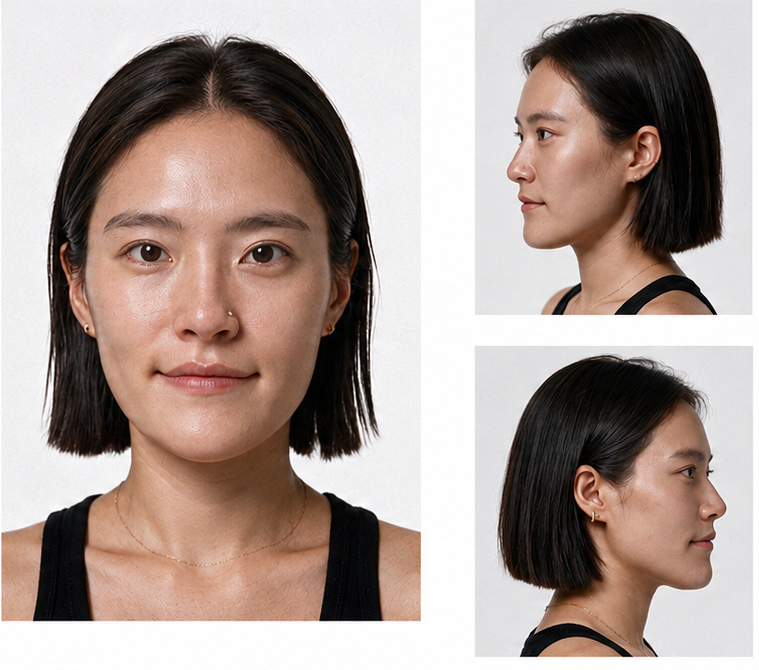
This is my reference photo — not available to download. Swap in your own clear photo here (front-facing works best) to preserve your own identity across all four eras.
15-second photorealistic cinematic fashion film, vertical 9:16.

CORE CONCEPT:

One woman walks continuously toward the camera while traveling through four radically different eras and cities:

1960 NEW YORK
→ 1990 SEOUL
→ 2026 PARIS
→ 2050 SAN FRANCISCO

The transitions should feel magical and extremely satisfying, but physically believable.

The SAME woman continues the SAME uninterrupted walking motion through the entire film.

Her facial identity, age, skin tone, facial structure, and body proportions remain completely identical throughout all four eras.

Only her HAIR, MAKEUP, CLOTHING, ENVIRONMENT, PROPS, VEHICLES, COLOR PALETTE, and CINEMATOGRAPHIC TEXTURE change to match each era.

Each era must look IMMEDIATELY and DRAMATICALLY different from the previous one.

This is not a subtle historical progression.

Every transition should feel like entering a completely different fashion film.

REFERENCE IMAGE:

Use the provided woman reference image ONLY to preserve her facial identity and body proportions.

Do NOT copy the reference image's clothing, background, pose, framing, lighting, or environment.

Preserve her exact recognizable facial identity throughout all four eras.

She remains the same age throughout the entire video.

CONTINUOUS CAMERA AND WALK:

The woman walks confidently and naturally straight toward the camera for the entire 15 seconds.

The camera smoothly tracks backward at the same speed, maintaining approximately the same medium-full framing.

Her walking speed remains constant.

Maintain exact spatial continuity across every transition.

If her left foot is moving forward before an occlusion, the next scene must continue naturally from that exact phase of the walking cycle.

Do NOT reset her walking animation after a transition.

Do NOT change her body position or distance from camera during transitions.

Every transition is hidden by a REAL foreground object physically passing extremely close to the lens and completely covering the frame.

No morphing.
No magical dissolve.
No digital transition.
No teleportation effect.

The world changes invisibly while the camera is physically occluded.

────────────────────

0.0–3.5 SEC — NEW YORK, 1960

Begin immediately in a visually unmistakable, glamorous interpretation of 1960s Manhattan.

The woman walks confidently down a lively Manhattan sidewalk.

WARDROBE:

She wears a striking cherry-red structured 1960s A-line mini dress with a clean geometric silhouette, fitted through the shoulders and flaring slightly at the skirt.

White knee-high leather boots.

Small structured white handbag carried naturally in one hand.

Oversized white-framed 1960s sunglasses.

Elegant gold stud earrings.

HAIR AND MAKEUP:

Her hairstyle becomes a glamorous polished 1960s bob with volume at the crown and softly flipped ends.

Graphic but elegant eyeliner, defined lashes, natural matte skin, subtle coral-red lips.

She should feel like the heroine of an expensive 1960s fashion film.

ENVIRONMENT:

Authentic-looking 1960s Manhattan.

Period storefronts.
Vintage theater marquees.
Newspaper stands.
Chrome-heavy American sedans.
Checker-style yellow taxis.
Pedestrians in period coats, suits, dresses and hats.

No modern cars, phones, LED screens, contemporary advertisements or modern street furniture.

CINEMATOGRAPHY:

Rich vintage 35mm motion-picture character.

Warm saturated reds and creams.
Subtle film grain.
Gentle halation.
Soft highlight roll-off.
Slightly softer vintage lens rendering.

Beautiful, glamorous and cinematic rather than documentary-like.

TRANSITION:

Around 3.5 seconds, a large period yellow taxi drives extremely close across the foreground.

Its body completely fills the entire frame for a fraction of a second.

While the frame is 100% physically blocked, change eras.

────────────────────

3.5–7.0 SEC — SEOUL, 1990

As the taxi clears, reveal the SAME woman continuing the EXACT SAME walking stride in 1990 Seoul.

The visual change should be immediate and dramatic.

This is a bold, colorful, highly stylized Korean 1990s retro aesthetic inspired by the most visually exciting interpretation of 1990s Korean pop culture.

WARDROBE:

Oversized vivid cobalt-blue varsity-style jacket.

Simple fitted white crop top underneath.

High-waisted light-wash baggy denim jeans.

Chunky white retro sneakers.

Colorful small hair accessories.

A few playful 1990s accessories without becoming costume-like.

HAIR AND MAKEUP:

Same exact woman and facial identity.

Her hair now has distinctly 1990s Korean styling: more volume, soft face-framing pieces, airy wispy bangs and playful hair clips.

Fresh youthful makeup with soft blush and slightly glossy lips.

ENVIRONMENT:

A visually dense, colorful 1990s Seoul commercial street.

Layers of vintage Korean Hangul storefront signs.
Old record and music shops.
Video rental stores.
Small restaurants.
Period advertising.
Public telephone booth.
Period Korean city buses.
Boxy Hyundai and Daewoo-era vehicles.
Busy sidewalks.

The street should feel energetic, colorful and unmistakably Korean.

Avoid modern Seoul elements.

CINEMATOGRAPHY:

Distinct 1990s Korean music-video aesthetic.

Punchier colors.
Slight analog softness.
Subtle VHS-era texture mixed with cinematic film photography.
Slightly faded highlights.
Energetic blue, pink, yellow and green accents.

Do NOT make the image low-quality or heavily degraded.

It should feel intentionally retro and fashionable.

TRANSITION:

Near 7 seconds, a large authentic 1990s Seoul city bus crosses extremely close in front of the camera.

The bus completely covers the entire frame.

During the complete physical occlusion, change eras.

────────────────────

7.0–10.5 SEC — PARIS, 2026

As the bus clears, reveal the SAME woman continuing seamlessly into contemporary Paris in 2026.

The image suddenly becomes dramatically cleaner, calmer and more sophisticated.

The contrast with colorful 1990 Seoul should be immediately noticeable.

WARDROBE:

Modern Paris fashion-week minimalism.

A fitted black top with a beautifully tailored long black coat.

High-waisted straight-leg black trousers.

Sleek pointed black ankle boots.

Narrow contemporary black sunglasses.

Minimal jewelry.

Small structured luxury-style black shoulder bag with no visible brand logo.

Everything feels expensive, understated and current.

HAIR AND MAKEUP:

Same exact facial identity.

Sleek contemporary bob with clean natural movement.

Minimal modern makeup.
Real skin texture.
Subtle complexion.
Natural lips.
No excessive beauty retouching.

ENVIRONMENT:

Elegant contemporary Paris.

Haussmann architecture.
Beautiful café terraces.
Modern pedestrians.
Current European vehicles.
Scooters.
Warm stone architecture.
Refined street furniture.

The palette is dramatically restrained compared with Seoul:

black, cream, warm beige, muted stone and subtle green.

CINEMATOGRAPHY:

Premium contemporary cinema-camera image.

Beautiful natural dynamic range.
Modern cinema lenses.
Realistic skin texture.
Soft highlight roll-off.
Subtle shallow depth of field.
Fine restrained film grain.
Elegant natural movement.

This should visually feel like the highest-end contemporary fashion campaign.

TRANSITION:

Around 10.5 seconds, a sleek black contemporary vehicle passes extremely close across the foreground.

It completely fills the frame.

During that brief complete occlusion, transition into the future.

────────────────────

10.5–15.0 SEC — SAN FRANCISCO, 2050

Reveal the SAME woman continuing the exact same stride in San Francisco in 2050.

This is the biggest visual payoff of the film.

The future must feel breathtaking but PLAUSIBLE.

Do NOT create generic cyberpunk.

The viewer should recognize San Francisco first and then gradually notice that something is very different.

WARDROBE:

Sophisticated 2050 high fashion.

A sculptural pearl-white and silver asymmetric coat with elegant architectural tailoring.

Subtle translucent technical fabric details.

Minimal fitted clothing underneath.

Sleek futuristic boots.

Small pieces of sophisticated metallic jewelry.

The outfit should feel like believable fashion evolution rather than a sci-fi costume.

No spacesuit.
No glowing clothing.
No armor.

HAIR AND MAKEUP:

Same exact woman, same age, same facial identity.

Her hairstyle becomes extremely clean and architectural: a sleek geometric bob with subtle futuristic precision.

Minimal luminous makeup while preserving completely realistic human skin texture.

ENVIRONMENT:

A recognizable but evolved San Francisco.

Classic San Francisco hills and preserved Victorian architecture remain visible, now integrated naturally with advanced sustainable architecture.

Elegant autonomous electric vehicles move through the streets.

Small delivery robots navigate sidewalks.

Subtle humanoid service robots coexist naturally among pedestrians.

Advanced glass and solar architecture.

Beautiful redesigned public infrastructure.

Quiet autonomous transit.

Technology is everywhere but treated as completely ordinary.

No flying-car traffic.
No giant holograms.
No neon cyberpunk city.
No Blade Runner aesthetic.

Use a sophisticated palette of pearl white, silver, glass, pale concrete and natural greenery.

CINEMATOGRAPHY:

Extremely refined near-future cinematic photography.

Pristine modern optics while retaining natural human texture.

Beautiful dimensional lighting.
Soft highlights.
Realistic shadows.
Subtle cinematic motion blur.

The world feels advanced, calm and expensive rather than fantastical.

FINAL MOMENT:

During the final 1–1.5 seconds, while the woman continues walking toward camera, a believable humanoid service robot casually walks past her in the opposite direction.

Neither the woman nor pedestrians react.

Advanced technology is completely normal in this world.

She continues walking confidently.

Tiny final hold.

CUT TO BLACK.

────────────────────

AUDIO — IMPORTANT:

NO MUSIC AT ALL.

NO background music.
NO soundtrack.
NO song.
NO score.
NO cinematic music.
NO transition music.
NO musical sting.

Generate ONLY realistic environmental sound appropriate to each era:

1960 New York:
vintage traffic, distant horns, footsteps, subtle city ambience.

1990 Seoul:
street traffic, old bus engine, pedestrians, subtle urban ambience.

2026 Paris:
modern traffic, footsteps, café and city ambience.

2050 San Francisco:
quiet electric vehicles, subtle autonomous machinery, footsteps, soft city ambience.

Keep all environmental audio restrained and realistic because music will be added separately during editing.

NO dialogue.
NO voiceover.

────────────────────

STRICT CONTINUITY:

The woman must remain clearly recognizable as the SAME PERSON throughout all four eras.

Same facial structure.
Same skin tone.
Same age.
Same height.
Same body proportions.

Do not morph her face between eras.

Do not make her younger or older.

Do not change ethnicity.

Do not introduce duplicate versions of her.

Walking motion must remain continuous across all four scenes.

Her framing and relative distance from camera must remain consistent.

Transitions happen ONLY while the lens is completely physically occluded.

────────────────────

STRICT NEGATIVES:

No generated captions.
No year labels.
No city labels.
No subtitles.
No logos.
No watermarks.
No interface graphics.

No music of any kind.

No magical transformation effects.
No morphing transitions.
No cross dissolves.
No portals.
No digital glitches.
No time-travel VFX.

No cyberpunk.
No dystopian future.
No excessive neon.
No hologram overload.
No flying-car spectacle.

No beauty-filter skin.
No plastic skin.
No waxy faces.
No excessive sharpening.
No HDR commercial look.

No identity drift.
No age changes.
No body-proportion changes.
No duplicate woman.
No malformed hands.
No extra fingers.
No unnatural walking.
No sudden camera jumps.
Daily Creative Drops ⚡
Keep Creating With Me 🤍
If you use one of these prompts, tag @aiwithdonna so I can see what you create.
More guides coming soon!